
A cloud investment is approved. An AI pilot gets underway. The technology works.
But the business still needs answers: Who owns the outcome? Are employees ready to use it? Is the data trustworthy? Will the investment improve performance, and how will we know?
These questions sit at the centre of the CIO’s evolving role. Technology leaders are expected to maintain reliable operations while helping the organisation decide how to compete, change and grow.
Recent industry research shows how far those expectations now extend. The discussions at IP Dimension’s CIO Roundtable: Crossing Borders brought their practical implications into focus.
The responsibilities that built the CIO role
The CIO has traditionally overseen the technology and information systems that enable an organisation to function. Depending on the business, this has typically included:
- Maintaining infrastructure, networks and enterprise applications.
- Keeping systems available and supporting employees.
- Managing technology budgets, suppliers and implementation projects.
- Overseeing data management, recovery and operational continuity.
- Coordinating security, governance and technology risk with relevant specialists.
- Aligning IT plans with the organisation’s business requirements.
Reliability, cost control and successful delivery have therefore been important measures of performance. TechTarget’s overview of the role describes its progression from a predominantly technical position towards a broader strategic leadership remit. Read TechTarget’s CIO overview.
These responsibilities remain essential. The challenge is that a growing set of expectations now sits alongside them.
What is changingand why it matters
The shift towards business leadership has been developing for years. AI is accelerating it.
Deloitte’s 2026 Global Technology Leadership Study, which surveyed 662 senior technology leaders globally, found that 79% identified driving business outcomes as their top priority. Yet 42% reported low or no return on AI investments. These findings cover technology leaders across several executive roles, including CIOs. Read Deloitte’s research findings.
That tension is significant. Expectations for value are rising, while achieving it remains difficult.
Deloitte’s wider analysis describes a dual requirement: leaders need technical depth alongside the ability to shape enterprise strategy, lead change and coordinate across functions. Read Deloitte’s analysis of technology leadership.
Gartner’s 2026 CIO Agenda similarly places emphasis on business outcomes, executive collaboration, AI returns and adapting vendor strategies to changing conditions. Explore Gartner’s CIO Agenda.
Taken together, these perspectives suggest an expanded leadership responsibility: helping the organisation make better decisions about technology, investment, risk and change.
A CIO can help establish an AI platform. Realising its value also requires business ownership, usable data, appropriate controls and people who can apply it effectively.
How those expectations play out in practice
At IP Dimension’s Crossing Borders roundtable, participants explored what this broader mandate means when decisions involve actual budgets, customers, teams and suppliers.
Three tensions stood out.
1. Innovation must earn its investment
Accessible cloud infrastructure and AI tools create more opportunities to experiment. They also make it easier to move ahead before a business problem has been clearly defined.
The discussion raised questions about solutions arriving ahead of genuine demand, the effect of exchange-rate volatility on cloud budgets, and the difficulty of measuring returns.
A useful starting point emerged: establish what needs to improve before deciding which technology to introduce.
For a leadership team, that means being able to explain the expected outcome, the full cost and the evidence that would justify further investment.
2. Flexibility has value beyond the initial purchase
The platform discussion surfaced three questions:
- Are we choosing the right platform?
- Will the investment deliver value?
- What happens if we need to reverse course?
That final question changes the investment conversation.
A solution may meet today’s requirements while creating dependencies that make tomorrow’s choices more difficult. The roundtable explored how supplier relationships, data sovereignty, training and cross-border requirements affect the ability to change direction.
These considerations also influence customer experience. A lower technology price does not, on its own, explain whether a transition will work well for employees or customers.
As Daniel Ntini put it:
“The IT industry needs to focus on 4 P’s: People, Processes, Platforms and Partnerships.”
3. AI readiness is an organisational responsibility
The discussion around AI repeatedly returned to business objectives, trusted data, governance and measurable returns.
These foundations require cooperation across technology, finance, operations and business leadership. They also require agreement on accountability: who defines success, who manages risk and who owns adoption.
The implication is practical. An organisation’s ability to benefit from AI depends partly on how well it can make and execute decisions together.
What should leaders examine next?
The global research describes an expanding CIO mandate. The roundtable adds context about the trade-offs involved in delivering it.
For organisations considering their next cloud or AI investment, that creates some important questions:
- Have we defined the business outcome clearly enough to measure it?
- Have we accounted for the people and process changes required?
- Do our data and governance arrangements support the intended use?
- Can we adapt if our requirements or supplier relationships change?
- What accountability should we expect from our technology partners?
These questions provide a useful starting point for a more informed executive conversation.
Explore the perspectives behind the discussion
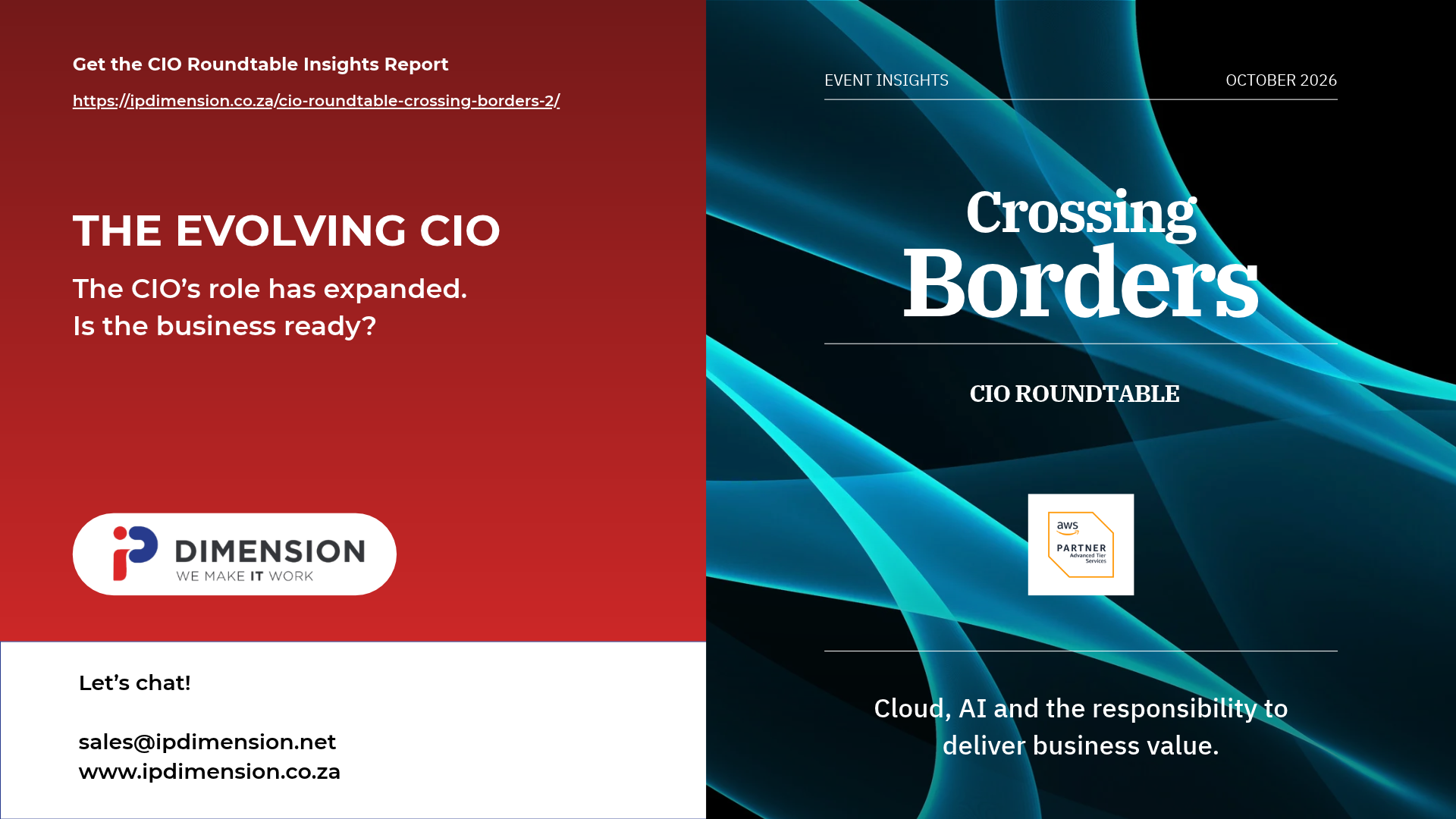
IP Dimension’s Crossing Borders: CIO Roundtable Insights report brings together perspectives from nine contributors on the changing CIO mandate, cloud decisions, customer experience and responsible AI adoption.
Inside the 19-page report, you can explore:
- The costs and dependencies that can be overlooked in platform and supplier decisions.
- Six areas requiring attention when moving AI beyond experimentation.
- How innovation speed connects to customer experience and business value.
- Five shared priorities for responsible technology leadership.
Use these perspectives to challenge assumptions and inform your next technology investment discussion.
Download Crossing Borders: CIO Roundtable Insights. Visit the link below, complete the short form and access your copy.
https://ipdimension.co.za/cio-roundtable-crossing-borders-2/
#CIO #TechnologyLeadership #CloudStrategy #ResponsibleAI #IPDimension
IP Dimension helps South African businesses replace reactive, single-person IT with a fully outsourced IT department — one flat monthly fee, a full team behind it, no emergencies, no surprises.
Get in touch because “we make IT work”!
 sales@ipdimension.net www.ipdimension.co.za
