
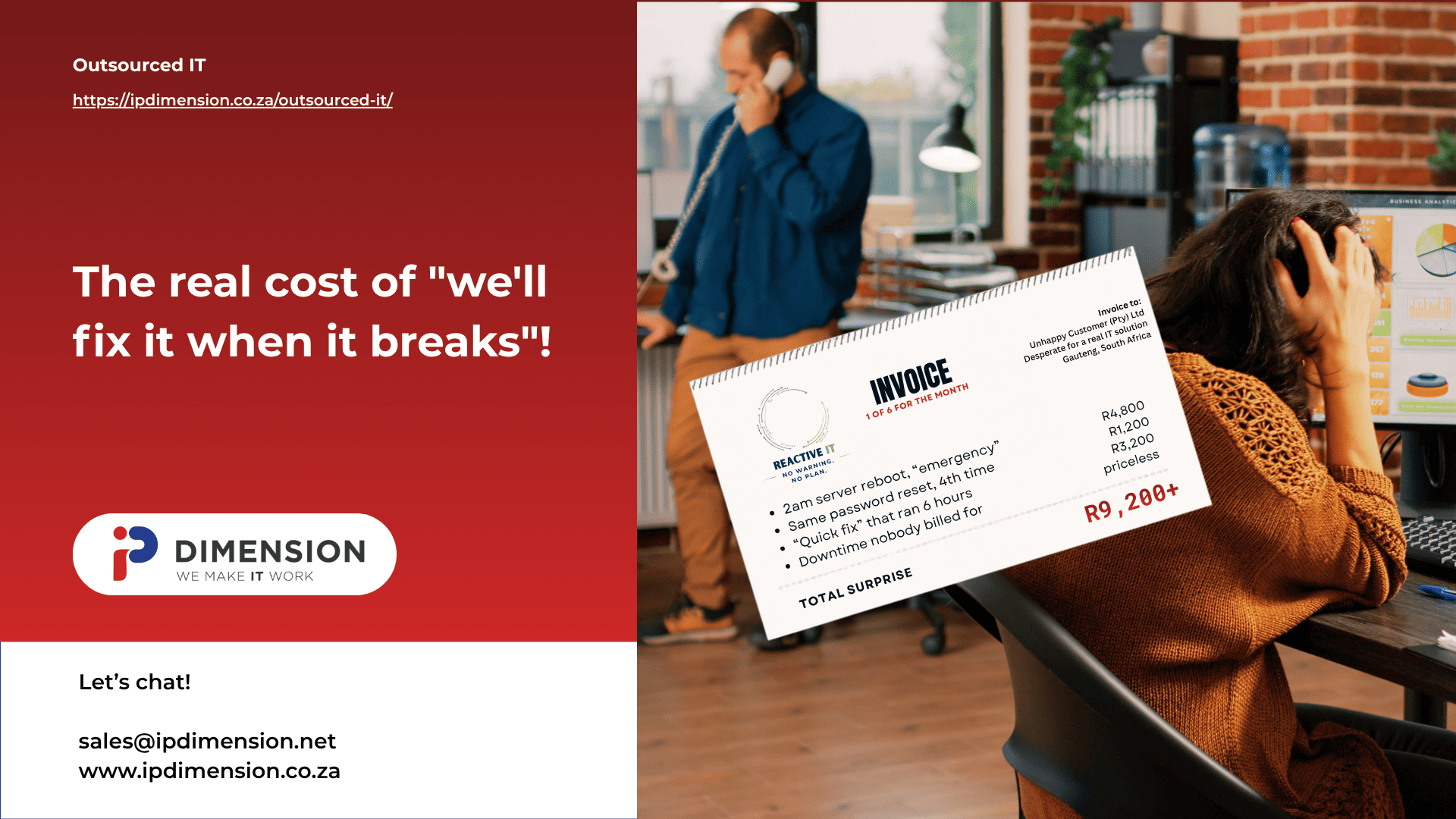
The real cost of "we'll fix it when it breaks"
Most businesses don’t budget for IT failure. They budget for IT, and then treat failure as an unplanned exception — an unlucky Tuesday, a bad week, a one-off. But reactive IT isn’t a series of unlucky weeks. It’s a business model, whether anyone chose it on purpose or not. And it has a real, calculable cost that most SMEs never actually add up.
Here’s what that model tends to look like in practice: nothing gets fixed until it breaks. Servers get rebooted at 2am because something “went down again.” Passwords get reset for the fourth time this month. A “quick fix” turns into six hours because nobody had visibility into the actual problem. None of it shows up as a single line item. It shows up as a callout fee here, a few hours of lost productivity there, an after-hours emergency rate nobody remembers agreeing to. It’s not one invoice. It’s a hundred small ones, scattered across a year, never totalled.
Do the maths on a fairly ordinary month and the number gets uncomfortable fast. A weekend emergency callout. A handful of repeat support tickets for problems that were never actually solved, just patched. A few hours of a team sitting idle because nobody could log in. Add it up and a business can be losing the equivalent of a full-time salary’s worth of productivity a year — without ever seeing it as a single, obvious cost. Reactive IT is expensive. It’s just never billed as one thing, so it never gets questioned as one thing.
The single point of failure nobody planned for
There’s a second, quieter risk sitting underneath the cost problem, and it’s structural rather than financial: most SMEs run their entire IT operation through one person, or nobody in particular.
That’s not a criticism of the person. It’s a criticism of the design. One IT hire — however good — cannot simultaneously be the network specialist, the cybersecurity expert, the Microsoft 365 administrator, the procurement contact, and the strategic planner thinking about where the business needs to be in eighteen months. Most businesses don’t need one generalist wearing five hats. They need a team. They just haven’t been able to justify hiring one.
And the risk isn’t hypothetical. What happens when that person is on leave and a critical system goes down? What happens when they leave the business entirely, taking a year of undocumented tribal knowledge — passwords, quirks, workarounds nobody else knows about — with them? What happens when a problem needs networking expertise on Monday and cybersecurity expertise on Wednesday, and the one person available is neither?
This is the part that doesn’t show up on an invoice at all. It shows up as risk sitting quietly on the balance sheet, waiting for a bad week to make itself known.
What the alternative actually looks like
Outsourced IT solves both problems at once, not by being cheaper in a trivial sense, but by changing the shape of the cost and removing the single point of failure entirely.
Instead of unpredictable emergency invoices, it’s one fixed monthly fee — no large upfront hardware or software spend, no onboarding charges, no long-term contract locking you in. Instead of one person covering everything, it’s a full team: helpdesk support with proper SLAs, proactive monitoring and automated patching that catches problems before they interrupt anyone’s day, procurement and supply chain relationships that get the right hardware at the right price, and actual strategic planning — IT roadmaps and regular check-ins — rather than a to-do list that only ever grows.
It’s also faster to stand up than most business owners expect. A properly run managed IT transition can be fully implemented in around two weeks, not the drawn-out, disruptive migration people tend to picture when they hear “outsourcing our IT.”
None of this is about IT for its own sake. It’s a financial decision and a risk decision dressed up as a technical one. Reactive IT costs more than it looks like it costs, and it depends on people who were never meant to carry that much on their own. Fixing both isn’t an upgrade. It’s closing a gap that was already there.
IP Dimension helps South African businesses replace reactive, single-person IT with a fully outsourced IT department — one flat monthly fee, a full team behind it, no emergencies, no surprises.
Get in touch because “we make IT work”!
👉 sales@ipdimension.net
👉 www.ipdimension.co.za